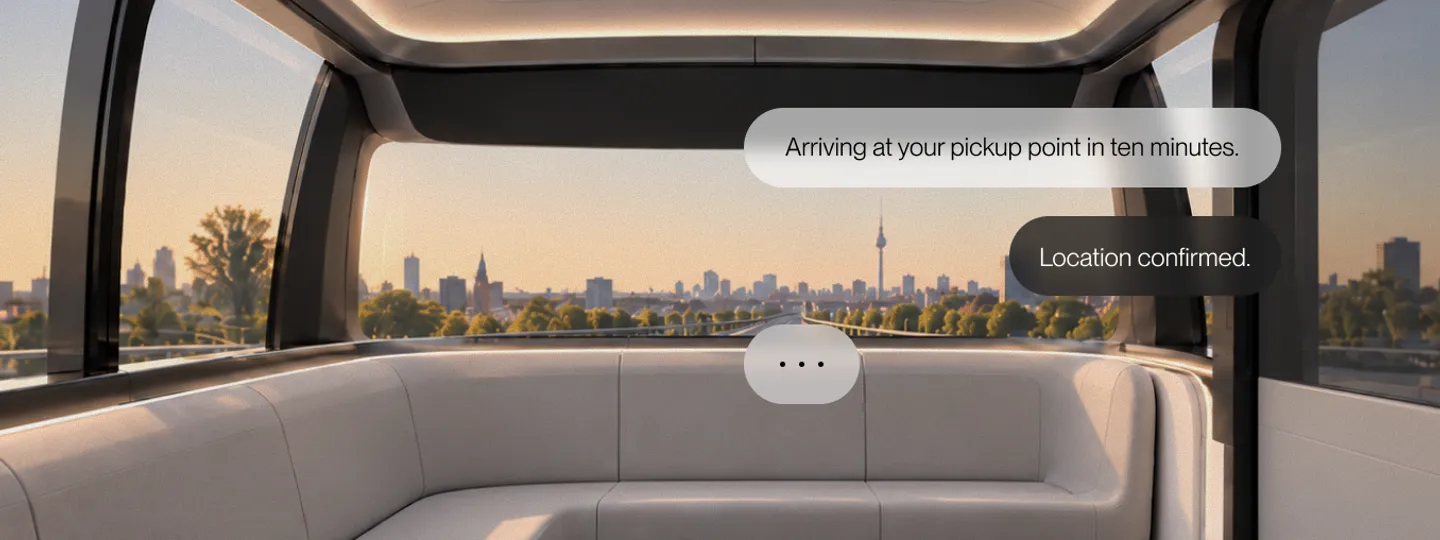
AI Mobility Assistant
At Volkswagen Future Center, my work spanned both L4 and L5 mobility, across safety, privacy, and productivity. This case study focuses on one piece of that: an in-car AI voice assistant for Level 5 vehicles. I reimagined its role across the journey, understanding what is happening in and around the vehicle, responding to passengers' needs, and offering help at the right moment without demanding their attention.
Company - confidential: the original Volkswagen work cannot be shown. All scenes, interactions, and visuals in this case study were newly created to reflect the design thinking and learnings.
The Brief
What role can an AI assistant play across the end-to-end passenger experience of a Level 5 vehicle?
I explored the assistant as a calm, context-aware presence that connects personal journey context across devices and supports passengers from planning through to arrival.
Hello, world!
From Vehicle to a Moving Room
A Level 5 vehicle is more than a car without a steering wheel. It is a moving room for a limited time. The journey begins with booking, continues through pick-up, boarding, and travel, and ends when the passenger leaves. It can be booked through a home assistant or phone, with only the necessary journey intent passed on. The vehicle does not need to know a passenger’s entire life only how to provide the right space and service for this journey.
A Spatial Host, Not a Chatbot
I defined the in-car assistant as a restrained spatial host: not a driver, not Siri, and not a chatbot that constantly seeks conversation. It knows who is travelling and receives the journey context each passenger has chosen to share, but uses this knowledge to support the moment, not to expose or overstep. By understanding both the passenger and the room, it can stay quiet by default and respond only when meaningful.
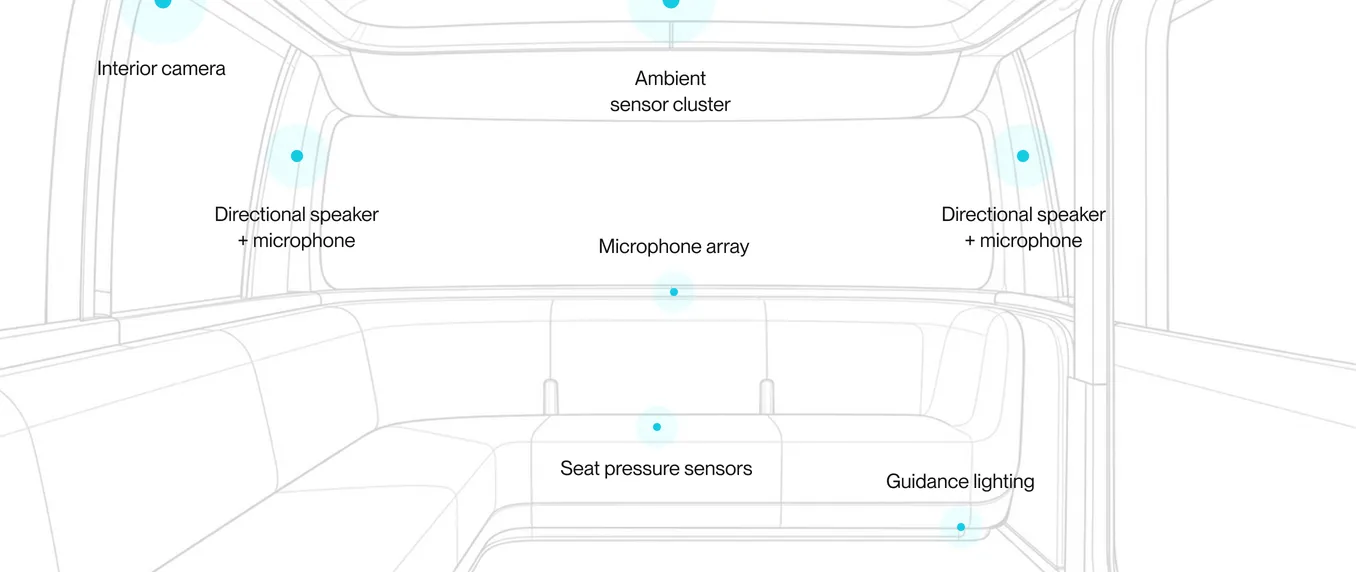
From this data the assistant infers events such as Emergency, Standard situation, Quiet mode, Violent case, Privacy mode, Motion sickness, Passenger asleep, Item left behind, Child on board, Cabin too warm, Stop request, Boarding, and responds to each.
How the Assistant Communicates
These scenarios show the assistant’s basic modes of communication. Through coordinated visual, voice, and haptic feedback, it makes its intent and responses clear without demanding the passenger’s full attention.
Principles for Autonomous Mobility Assistants
Drawing on my work on future-mobility projects at Volkswagen Future Center, I distilled these principles to guide the assistant’s behaviour. They frame how it can be helpful without becoming intrusive, personal without exposing privacy, and present without competing for attention in the cabin.
Be Contextual, Not Constant
The assistant should respond to the passenger’s current needs, journey stage, and surroundings. Help should appear when relevant, rather than continuously competing for attention.
Make Autonomy Understandable
Passengers should always have a clear sense of what the vehicle is doing, why it is doing it, and what will happen next. Transparency helps reduce uncertainty and build trust.
Keep Users in Control
Even in a fully autonomous vehicle, passengers should be able to adjust, dismiss, or override assistant suggestions. Automation should support decisions, not remove agency.
Protect Privacy by Default
Personal information, conversations, destinations, and preferences should remain private unless the user chooses to share them. Sensitive interactions should avoid unnecessary visual or audible exposure.
Balance Personal and Vehicle Context
The assistant should distinguish between personal information and vehicle-level updates. Notifications, audio, and screen content should keep personal needs private while making the journey easy to understand.
Support Seamless Transitions
Assistance should adapt naturally as the journey moves from boarding to travelling, approaching the destination, and exiting. Passengers should not need to repeatedly reorient themselves.